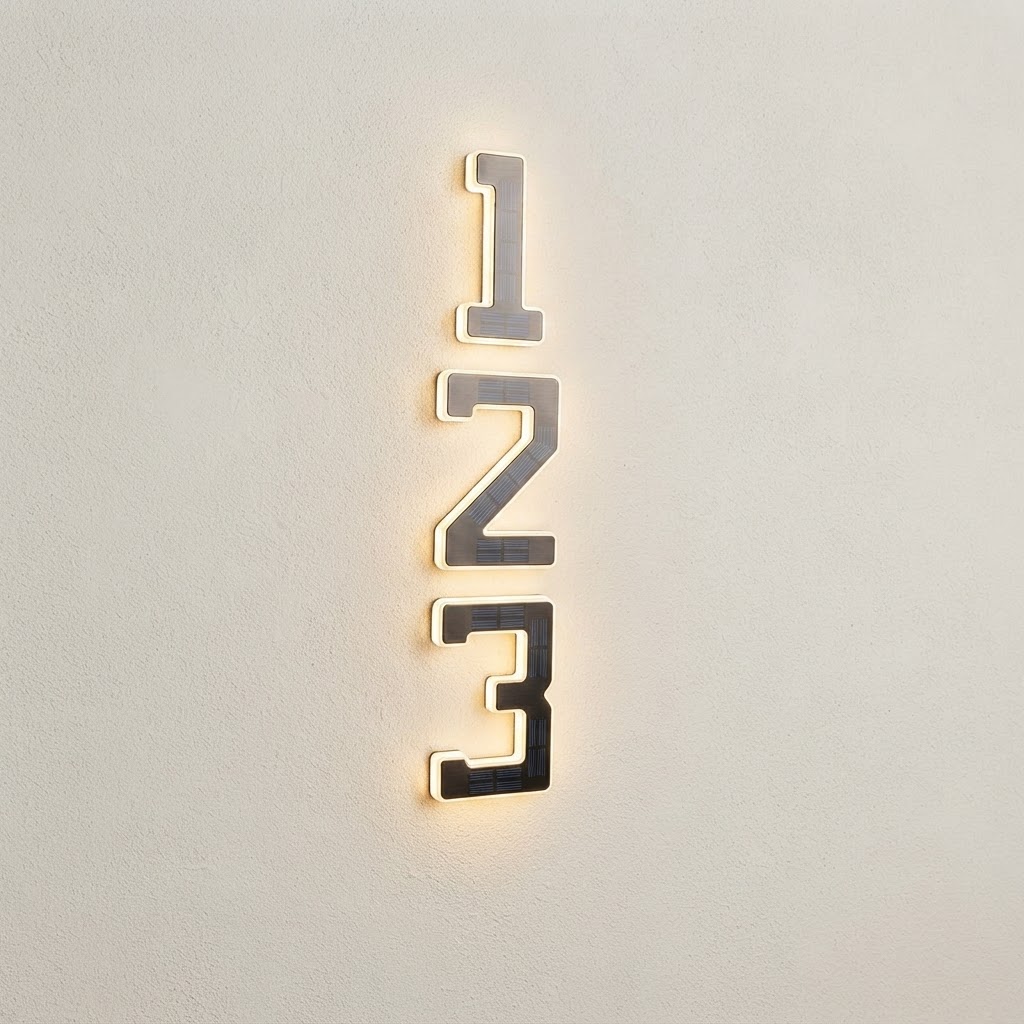
The Comprehensive Guide to Solar Lighted House Numbers
Importance of High-Visibility Address Plaque Design
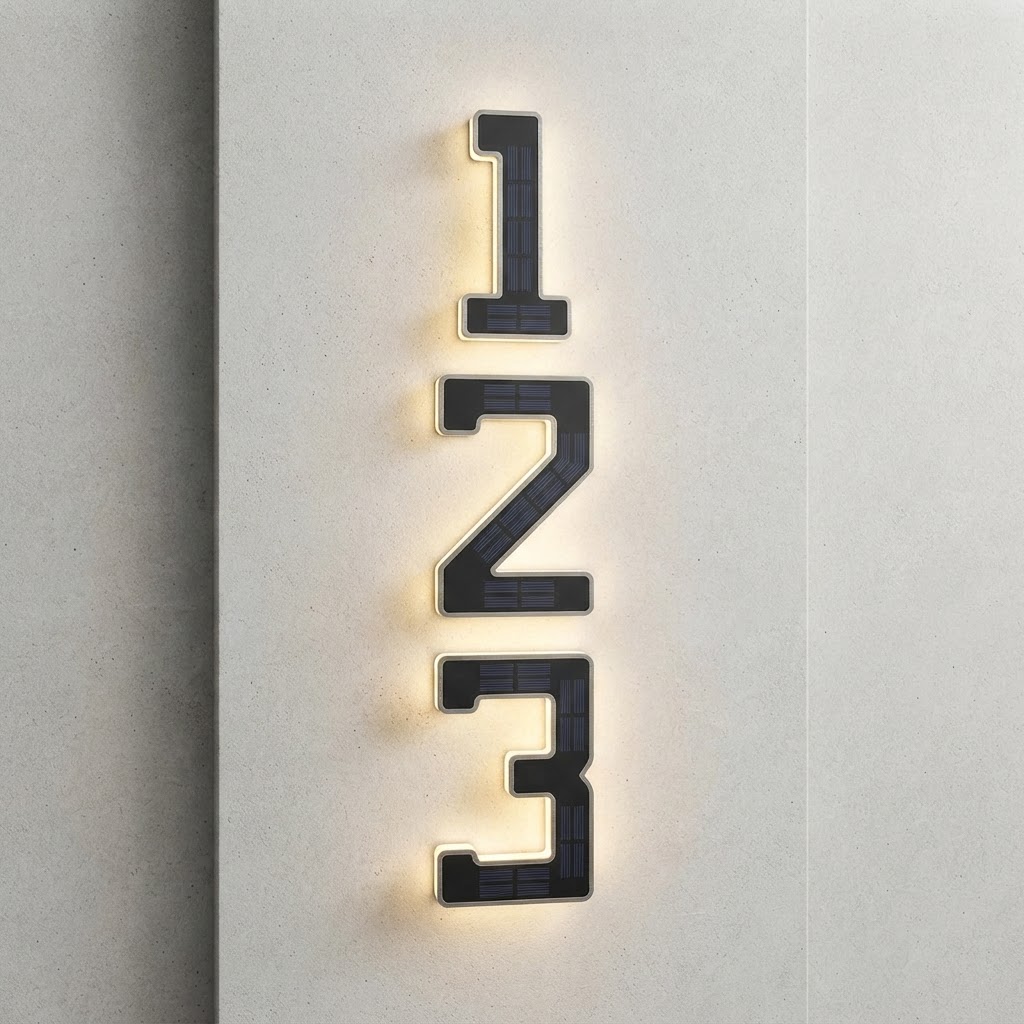
Finding a home during nighttime hours can present a challenge for delivery drivers, guests, and critical emergency services. Traditional house numbers often depend on ambient street lighting or porch lights that fail to illuminate specific digits clearly. Implementing clear, direct lighting on exterior address signs ensures your home is easily identified from the street under all lighting conditions.
A clear, stylish black and white design combined with warm LED illumination offers optimal contrast and visibility. High contrast ensures that whether emergency personnel are searching for your home or a delivery driver is dropping off a parcel, your property remains easily locatable without unnecessary delay. There is a free test that settles whether this matters at your own house. After dark, walk to the middle of the road, stand where a driver would stop, and try to read your number. Most people cannot.
The usual causes are consistent: no illumination, dark digits against dark brick or a dark door, planting that has grown across the number over a few seasons, and a number set back inside a shadowed porch where no street light reaches.
Contrast is the variable that gets misdiagnosed. Faced with an unreadable number, the instinct is to buy bigger digits, but size does much less at night than contrast does. A modest number with a genuinely light background behind it reads from further away than a large one in a dark finish on dark masonry, and adding light solves the problem outright.
Key Benefits of Solar-Powered Exterior Lighting
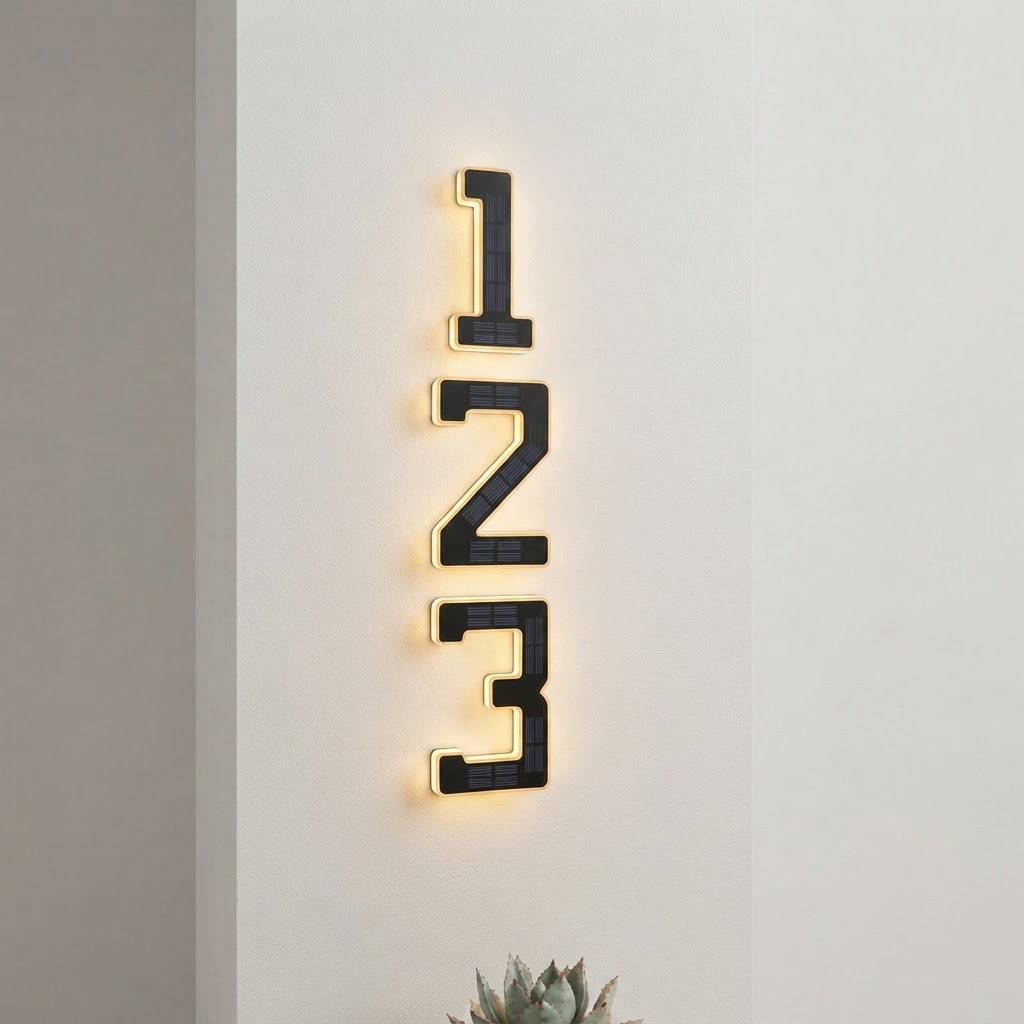
Upgrading to solar house numbers eliminates complex wiring, electrician fees, and continuous operational electrical costs. Built with integrated solar panels on the surface, these address units harness direct sunlight throughout the day to recharge internal energy stores.
Equipped with a 600mAh NI-MH battery, charging for 6-8 hours under sufficient sunlight provides reliable performance with up to 12 hours of continuous illumination throughout the night. Built-in automation further simplifies maintenance: an intelligent light sensor automatically triggers the light on at night and powers it off during daylight hours. Set against those benefits, three limitations are worth stating plainly so the choice is made with open eyes.
Output depends on the day's sunlight. Short winter days and a low sun angle mean shorter run times, and a unit that lasts until dawn in June may fade in the small hours in December. Snow on the panel stops charging completely until it is cleared.
The battery is a consumable. Nickel-metal hydride cells hold capacity well for the first two years or so and then decline, so expect noticeably shorter evenings by the third or fourth winter.
And the energy saving is negligible. LED address lights draw so little power that a mains equivalent costs pennies a year to run, so the case for solar rests on installation, siting freedom, and independence from the grid, not on the electricity bill.
Key Features of Modern Address Signs
When evaluating modern lighted signs, key functional features include:
- Warm LED Illumination: Modern House Number Light with warm LED illumination ensures readable numbers without harsh light output.
- Solar Autonomy: Powered by direct sunlight with an internal 600mAh NI-MH battery.
- Automated Light Sensors: Intelligent Light Sensor for automatic on/off operation dusk-to-dawn.
- Weatherproof Construction: Built with IP44 Waterproof rating and durable ABS & PC construction.
- Tool-Friendly Setup: Easy to Install with included screws and positioning paper.
Contrast and typeface come first, because legibility is the entire function and everything else is in service of it.
Panel size and mounting position come second, and they should be considered together. A large panel on a shaded wall collects less than a small one in open sun, which makes the wall you choose part of the specification.
The light sensor is third, and its failure mode is worth knowing in advance: a nearby porch lamp or street light shining onto it will keep the unit from ever switching on, and this is the most common complaint with any solar fixture.
Battery replaceability is fourth, and it quietly determines the lifespan of the whole product.
UV stabilisation of the plastics is fifth and matters chiefly on a sun-facing elevation, where an untreated housing goes chalky and a polycarbonate lens yellows within a few years.
The IP rating comes last, not because sealing is unimportant but because almost everything sold in this category is adequately rated, so it rarely distinguishes one unit from another.
Installation and Durability Standards
Exterior fixtures must withstand continuous environmental exposure. Products made of durable ABS & PC material offer strong structural integrity capable of enduring harsh outdoor conditions. Coupled with an IP44 waterproof rating, these lighting units are designed to withstand rain, snow, and UV rays without premature degradation or fading.
From an installation standpoint, direct-mount solar address units require minimal structural disruption. Designed for straightforward DIY mounting, setup cost is estimated at $0 (DIY) when using basic hand tools. Included mounting aids like positioning paper simplify exact hole alignment on various exterior siding materials, including wood, brick, or vinyl. Fixing method follows the wall. Timber, composite, and vinyl cladding take the supplied screws directly, with the caveat that vinyl siding expands and contracts and should never be screwed down hard. Brick, block, and render need a masonry bit and wall plugs, and drilling into the mortar joints rather than the brick face is easier, holds well, and is far simpler to make good later. Fibre cement needs slow drill speed and light pressure to avoid chipping.
Height and alignment deserve more care than they usually get. Around eye level, roughly 150 centimetres, clears planting and parked cars while staying readable from a car window. Because a plaque is viewed head-on from the street, even a slight tilt is conspicuous from the pavement, so check the marks with a spirit level before drilling rather than discovering it afterwards.
On durability, the realistic expectation is that the housing outlasts the battery. Ultraviolet exposure gradually chalks the plastics on a south-facing wall, and the lens gasket hardens over the years, but the cell is what typically ends the fixture's useful life. Whether that cell can be swapped is the difference between a product that lasts a few years and one that lasts a decade.
Selecting the Right Lighting Setup for Your Home
Choosing an ideal home address fixture depends on visual aesthetic preferences, structural placement, and warranty considerations. At a competitive price point of $24.99, solar-powered house numbers deliver clear practical utility alongside clean, modern aesthetics.
Before finalizing your home setup, consider mounting location factors such as direct daily sunlight exposure, overall clearance on your wall or plaque area, and coverage terms under the manufacturer [warranty period] not specified. Ensuring continuous sunlight exposure guarantees maximum run time during longer winter nights.
Work through it in this order and the decision usually makes itself.
Start with the wall, not the product. Watch the intended position through a full day and note when it falls into shade, remembering that bare winter branches will be in full leaf by summer. If nothing on the front elevation gets meaningful sun, a solar unit is the wrong choice and a wired fixture is the honest answer.
Then measure the setback, because that sets the digit size. Judge it from where a car stops rather than from the front step.
Then check the sensor's surroundings for competing light. A porch lamp or street light shining directly onto the unit is the most common reason a good product never switches on, and it is far easier to design around before mounting than after.
Then match the finish to the door furniture and any porch lantern, so the number reads as part of the house rather than as an addition.
And finally, before drilling, ask whether the battery can be replaced. It is the single question that most affects how long the fixture will still be doing its job, and it is the one least often asked.
Related in this cluster
- Why Every Home Needs Solar Address Signs for Curb Appeal and Safety
- How to Install Solar Lighted House Numbers Step-by-Step
- Solar vs. Hardwired Address Lights: Which Is Right for Your Home?
- Buyer's Guide: What to Look for in Outdoor Address Lighting
- Solar Lighted House Numbers FAQ: Everything You Need to Know
- 5 Reasons to Upgrade Your Exterior Plaque with LED Solar House Numbers