Where to Install Solar House Numbers for Maximum First-Responder Visibility
Install solar house numbers for first-responder visibility on the elevation a vehicle actually uses, at a height that clears shrubs and parked cars, with about 50 feet of unobstructed street view and enough daylight for a 6-8 hour charge. Warm LED numerals on a black-and-white face only help if the plaque is already on at dusk and not hidden by a column. If the sunniest wall is the wrong street, add a mailbox or post on the true approach instead of decorating the shaded gable.
The approach line is the placement, not the front door
Responders follow the road they are on. A plaque centered on a door that sits 40 feet off the curb behind a hedge is a porch decoration. Stand where a vehicle slows, look for the numerals, and only then pick a screw line. The listed 50-foot readability is the distance class when nothing blocks the face.
Corner lots and alleys have two approach lines. The primary street still needs the primary plaque. A second solar face on the alley is optional; a single plaque aimed at the garden is not a substitute.
The solar address sign placement guide balances sightlines and sunlight as a general map. This page is the emergency filter: the plaque must be findable at speed, at night, without house power.
Height, clutter, and the 50-foot read
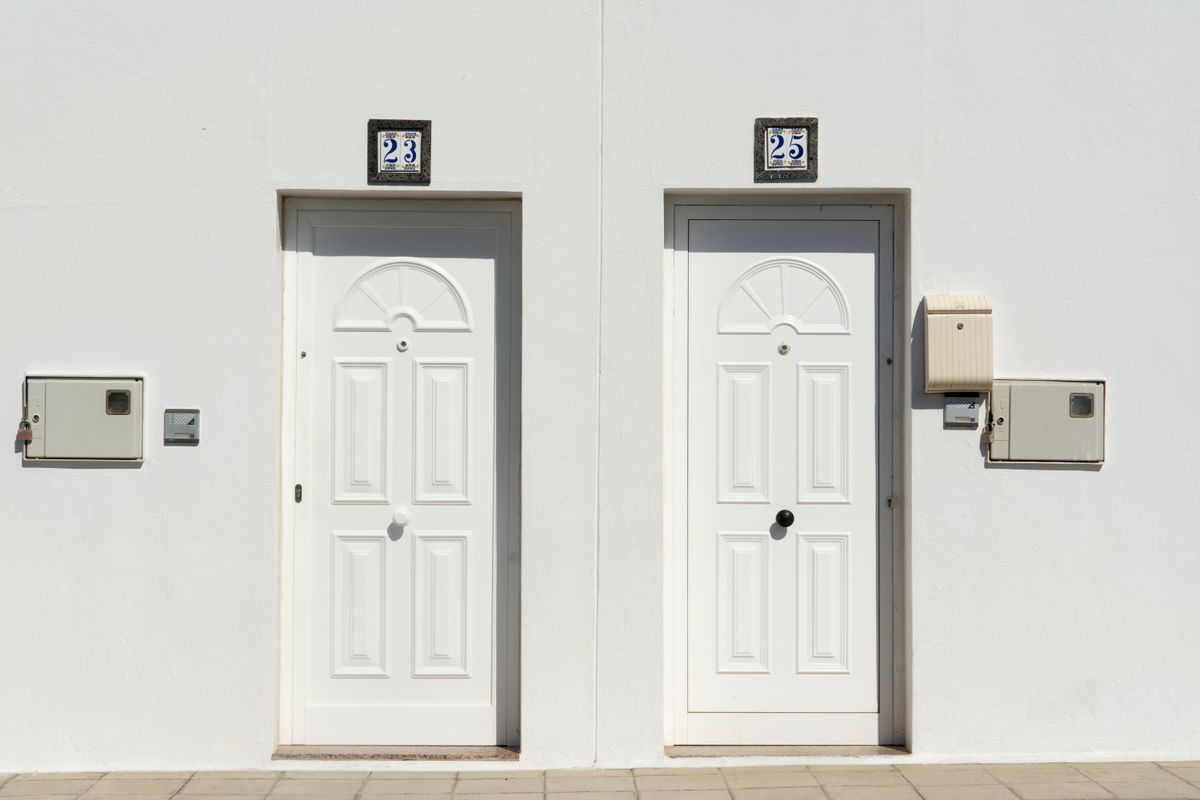
Photo by Jan van der Wolf on Pexels
Too low and a parked car eats the numerals. Too high under a dark soffit and the solar panel starves while drivers look at the wrong band of the wall. Use the positioning paper, then walk to about 50 feet and check both directions of travel. Mature shrub height is the summer problem; snowbanks are the winter problem.
Columns, flags, and hanging baskets create the same miss as a hedge. If the only clear rectangle of wall is off-center, off-center is correct. Symmetry is not an emergency standard. See optimal house number height for street visibility for the height band; keep this decision tied to responder approach.
Warm LED contrast fails if the face is edge-on to the street. Rotate the plaque toward the travel lane, not parallel to a receding wall. A tilted ABS and PC housing that chases a design line can hide digits from the driver-side window.
Sun still has to fill the pack
An intelligent light sensor will not save a 600mAh Ni-MH cell that never charged. Sufficient light for 6-8 hours is what supports about 12 hours of illumination. A perfect curb view on a deep north porch is a daytime-only sign after a string of gray days.
When sun and street fight, street wins for the numeral location, and a second charge-friendly site may be needed. A mailbox or yard post in open sky can carry the same warm LED job. Do not hide the house wall plaque in a sun pocket that responders never look at.
Keep decorative floods off the sensor. A sign that stays dark because the porch thinks it is noon is a placement error. IP44 handles weather on that wall; weather is not the first-responder problem if the face cannot be seen.
Placement choices against the emergency job
| Location | Responder view | Charge | Use when | | --- | --- | --- | --- | | Street-facing wall, clear | Best | If that wall sees sky | Default | | Door wall behind a porch | Often poor | Often poor | Only if that is the true approach | | Mailbox at the curb | Excellent from the road | If the box sees sky | Long drive or hidden house | | Side gable, pretty sun | Wrong street | Often good | Never as the only plaque | | Low in a hedge line | Blocked | Shaded | Never |
One plaque, two jobs: seen and charged
First-responder placement fails in two quiet ways: the crew cannot see the digits, or the digits are dark because the panel sat in shade. Both are siting. DIY screws and positioning paper make it cheap to test a rectangle of wall before committing. After the first full charge, watch dusk from the curb, not from the hallway.
First-responder placement checklist
Photo by Lübna Abdullah on Pexels
- [ ] Stand on the true approach and find a 50-foot rectangle of wall.
- [ ] Raise the plaque above parked-car and shrub height.
- [ ] Aim numerals at the travel lane, not the garden.
- [ ] Confirm the solar face still gets a 6-8 hour charge window.
- [ ] Keep porch lamps off the intelligent light sensor.
- [ ] Add a mailbox plaque only after the street-facing job is covered.
Frequently asked questions
Is the front door always the right wall?
No. The right wall is the one a responder sees from the road they are driving. Doors set back from the curb often lose.
How far should the numerals remain readable?
Readability is listed at 50 feet when the site is clear. If the current view is shorter, move the plaque or cut the clutter.
Can one mailbox sign replace the house wall?
It can mark the driveway. Crews still need a lit numeral at the structure they are entering if that wall is where they leave the street.
What if the sunny wall faces the wrong street?
Put the readable plaque on the approach and give it the best charge you can. A second unit can take the sunny, wrong-street wall if needed.
Do local responder rules specify height?
Some jurisdictions do. Follow the posted local rule when it exists; otherwise use a clear, 50-foot curb read above clutter.
Related reading
Sightline balance, mounting height, and responder visibility standards sit next to this emergency placement filter.
- solar address sign placement: street sightlines and sunlight
- how high to mount address signs for street visibility
- emergency responder address visibility standards
What to do next
Tonight, stand on the approach a responder would drive and see whether the current numerals hold at about 50 feet. Tomorrow, pick the rectangle of wall that keeps that view and still charges the panel. Tape the positioning paper there, keep glare off the sensor, and only then drive the screws.
Cover photo by Jan van der Wolf on Pexels.