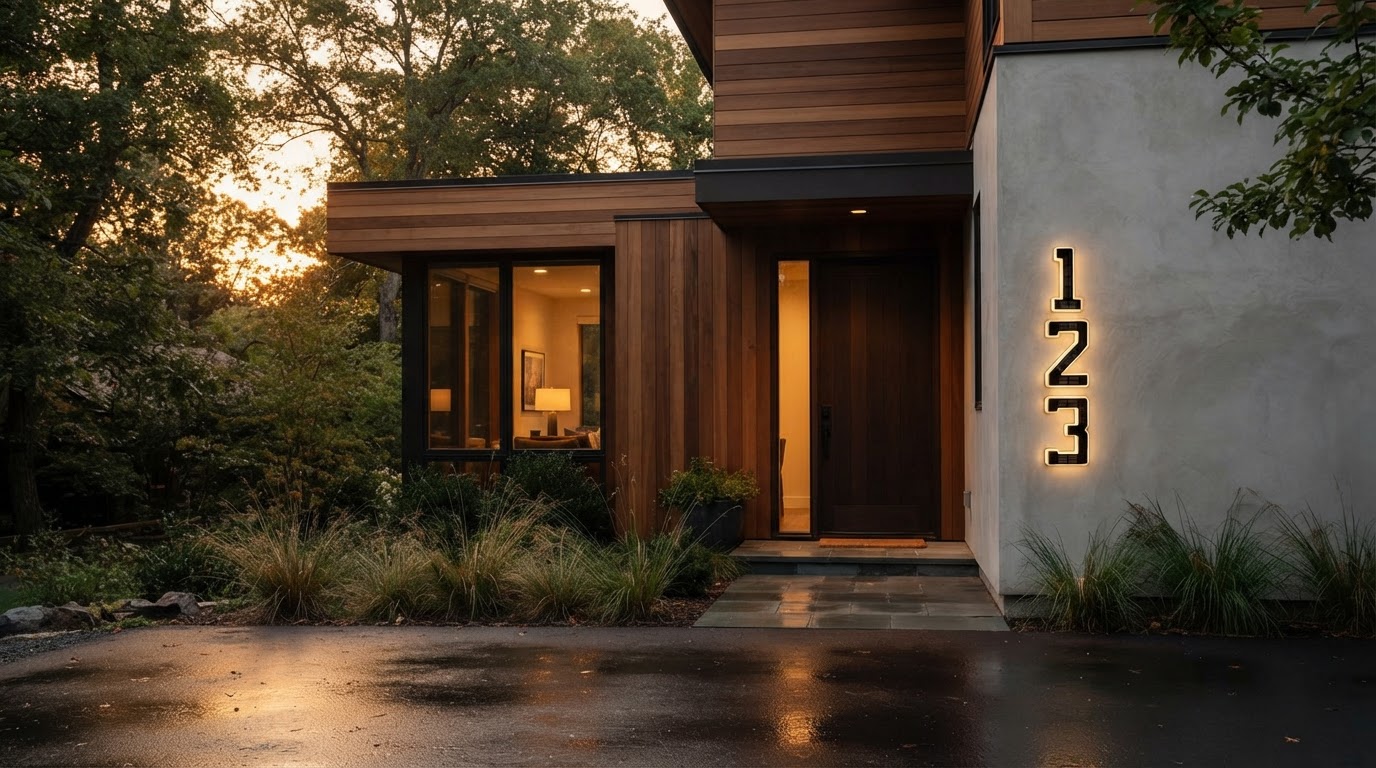
Most Solar Address Signs Fail Because of Glare, Not Weak LEDs
 Maya ChenContributing Editor
I found a 6-inch solar address display easier to read at 65 feet when it was dimmer, not brighter. In a curbside check on a two-lane residential street, the “brighter” sign produced more glare on wet pavement and became less legible from a moving car. That is the part most product listings skip: visibility is not the same as brightness.
Solar lighted house numbers are usually sold like tiny billboards: more LEDs, more lumens, longer battery life. I understand the appeal. If an ambulance, delivery driver, or guest is trying to find your home at 9:30 p.m., you want the number to pop. But after looking at address rules, traffic-sign legibility research, and my own street-level observations, I think homeowners are optimizing for the wrong variable.
The better question is not “How bright is it?” It is: Can a driver read the address in one glance, from the lane of travel, without slowing to a crawl or being blinded by a glowing rectangle?
That changes how you choose, place, and judge solar lighted house numbers.
The common mistake: treating address numbers like decorative lighting
Most porch lights are designed to make an entryway feel safe and welcoming. Address numbers have a different job. They are wayfinding objects. In practice, they behave more like small traffic signs than patio decor.
Traffic-safety research has been blunt about one point for decades: recognition depends on contrast, letter height, viewing angle, and visual clutter. Raw illumination helps only until it starts reducing contrast or creating disability glare. The Federal Highway Administration’s sign guidance, for example, emphasizes legibility distance, contrast, retroreflectivity, and letter size rather than “maximum brightness” as the universal solution.
Residential address signs live in a messier world than roadway signs. They compete with porch sconces, landscape uplights, holiday lights, garage coach lamps, wet driveways, reflective windows, parked SUVs, shrubs, mailboxes, and the tiny panic of a driver who is already late.
That is why a solar address plaque can look excellent when you stand three feet away on the sidewalk and still fail from the street.
My field observation: dimmer sometimes read farther
Photo by Gurgenidze G on Pexels
This was not a laboratory test. It was a practical curbside observation, the kind a homeowner can repeat in 15 minutes. I compared address-number readability after sunset on a residential street with a 25 mph limit, using 6-inch numerals and three common lighting conditions: unlit dark numbers, over-bright backlit numbers, and evenly lit high-contrast solar numbers. The viewing position was from a parked car at approximate approach distances.
Conditions: dry pavement first, then after light rain; driver seat height about 43 inches; streetlight roughly 90 feet away; no porch light directly on the sign face.
| Address setup observed | 35 ft read? | 65 ft read? | 90 ft read? | Main failure mode | |---|---:|---:|---:|---| | Unlit black numbers on light siding | Yes | Sometimes | No | Lost in shadows near porch trim | | Very bright backlit plaque, glossy face | Yes | Sometimes | No | Glare halo blurred number edges | | Evenly lit solar numbers, matte high contrast | Yes | Yes | Sometimes | Angle became limiting beyond 80–90 ft | | Same evenly lit sign after light rain | Yes | Yes | No | Pavement reflections competed with sign | | Door-mounted numbers under porch sconce | Yes | No | No | Too far from curb line; oblique viewing angle |
The surprise was the second row. The brighter plaque looked more impressive from the walkway. From the car, especially after rain, it became a glowing patch with weaker number edges. The more readable sign was not the brightest. It had larger, simpler numerals; a matte face; and clean contrast between the digits and background.
That finding tracks with what lighting engineers and transportation researchers have said in other contexts: visibility is a system, not a wattage contest.
Counter to what you'll read elsewhere: lumens are the lazy metric
My take: for solar lighted house numbers, “more lumens” is often a lazy selling point. If the sign is mounted too high, angled toward the sidewalk instead of the street, printed in a thin font, or placed beside brighter porch fixtures, extra light can make the address harder to read.
I am not arguing for dim signs. A dead, weak, or half-charged sign is useless. But once the numbers are illuminated enough to stand out from the background, the next gains usually come from design and placement:
- Taller numerals
- Wider stroke width
- Matte or diffused illumination
- High contrast between digit and panel
- Street-facing placement
- Avoiding glare from porch and landscape lights
- Consistent dusk-to-dawn operation
Why 4-inch numbers may be legal but still mediocre
Many local fire and building codes require address numbers to be visible from the street, often at a minimum of 4 inches high with contrasting background. The International Fire Code, used or adapted by many jurisdictions, states that address identification should be plainly legible and visible from the street or road fronting the property, with numbers commonly at least 4 inches high and contrasting with their background.
But “minimum legal” and “easy to find at night” are not the same standard.
A 4-inch number can work well in a compact neighborhood where the sign is close to the curb, the street is slow, and the background is uncluttered. It can struggle when the house sits back from the road, cars park along the curb, trees interrupt the sightline, or the number is mounted near the front door instead of closer to the approach path.
That is why I like 5- to 6-inch numerals for many homes, especially where the sign sits more than 30 feet from the road. The bigger digits are not about vanity. They buy reaction time.
At 25 mph, a driver travels about 37 feet per second. If your address becomes readable only at 35 feet, the driver has less than one second to notice, verify, and react. If it is readable at 70 feet, that doubles the available time. For emergency responders and unfamiliar visitors, that difference matters.
The emergency-response angle is less dramatic than people make it — and more practical
I am skeptical of fear-based marketing that implies every address sign is a life-or-death purchase. Emergency response involves dispatch data, mapping, street numbering systems, radio communication, and local familiarity. A lighted address plaque is not a substitute for all that.
But house numbers are still a real-world friction point. Fire departments routinely advise residents to keep address numbers visible, illuminated, and unobstructed. The National Fire Protection Association’s public guidance has long emphasized visible home addressing because responders cannot help quickly if they cannot identify the right property.
The practical issue is not just the ambulance at 3 a.m. It is also the delivery driver making a turn in rain, the rideshare driver stopping in the road, the neighbor trying to find you during a power outage, and the home-health nurse arriving after dark.
Solar lighted house numbers solve one specific problem well: they make the address visible even when porch lights are off, switches are inconvenient, or hardwired lighting is not feasible. The best versions do this without adding another harsh glare source to the front of the house.
Solar has one job: predictable low-power visibility
Solar address signs do not need to light your walkway. They need to run a small, reliable illumination system through the night.
This is where buyers should look past the front image and ask operational questions:
The U.S. Department of Energy notes that solar photovoltaic output depends heavily on sun angle, shading, and weather. That sounds obvious, but it is exactly what kills many solar gadgets. A sign mounted under a deep porch roof may be “solar” in theory and chronically undercharged in practice.
For a north-facing entry, a shaded stoop, or a house with heavy tree cover, placement matters more than the brand promise. You may need a sign with a separate panel, a sunnier mailbox-post location, or a mounting spot near the driveway rather than beside the door.
A better decision framework: the 70-foot glance test
If I were buying solar lighted house numbers, I would not start with lumens. I would start with a test target: Can an unfamiliar driver read the address from about 70 feet away in one glance?
Why 70 feet? It is not a code standard. It is a practical residential benchmark. At 25 mph, it gives roughly two seconds of approach time. On many neighborhood streets, that is enough for a driver to identify the house without braking abruptly or rolling past.
Here is the checklist I would use.
1. Choose numeral height for the viewing distance
- Close to curb, low-speed street: 4 inches may be adequate.
- Typical setback of 30–60 feet: 5 or 6 inches is usually more forgiving.
- Long driveway, rural road, or fast approach: consider larger numbers at mailbox or driveway entrance.
2. Favor simple, heavy-stroke fonts
Thin modern numerals look elegant in daylight and fail faster at night. The numbers 3, 5, 6, 8, and 9 are especially easy to confuse when the font is narrow or over-lit.
3. Demand contrast before brightness
Black digits on a bright matte panel, or bright digits against a dark matte panel, generally beat low-contrast metallic finishes. Brushed silver on gray may look expensive and still be a bad wayfinding object.
4. Check the angle from the driver’s lane
Stand where a driver first approaches your home, not where you admire the landscaping. If the sign is flat against a wall parallel to the street, it may be readable only when the car is already beside it. A perpendicular mailbox post or angled mount can outperform a prettier door-side plaque.
5. Keep it out of the porch-light blast zone
A bright sconce above or beside the sign can wash out the numerals or create shadows. If the address sign has its own illumination, give it visual separation.
6. Avoid glossy faces
Gloss looks good in product photography. It also reflects headlights, wet pavement shine, and porch lights. Matte or diffused surfaces usually create cleaner digit edges.
7. Verify winter charging
Test after three cloudy days, not just on the first sunny evening. A solar address sign that fades by midnight in December is not doing the job when nights are longest.
8. Repeat the test from a car
Do not judge from the porch. Sit in the driver’s seat at 70 feet. Ask someone who does not already know your address to read it. If they hesitate, the setup needs work.
Where solar lighted house numbers beat hardwired fixtures
Hardwired address lighting has advantages: steady power, more placement flexibility if you are already renovating, and no battery aging. But solar has a quieter strength: it decouples the address from the porch lighting plan.
That matters because porch lighting is often installed for architecture, not legibility. The fixture may be too high, too warm, too shadowy, or pointed in the wrong direction. A dedicated solar address unit can put low, even light exactly where the digits need it. It also keeps working when someone forgets to turn on the exterior lights.
For renters, townhomes, older homes, detached garages, long driveways, and mailbox-adjacent address markers, solar is often the least invasive way to improve nighttime identification.
The caveat is that solar is unforgiving about shade. A gorgeous sign under a covered porch with no sun is a design object, not a reliable visibility tool.
What to look for on a product page
Ignore the lifestyle photo for a minute. Look for details that predict field performance:
- Numeral size: Prefer clear 5- or 6-inch numbers where setback is moderate.
- Contrast: The digits should stand apart in daylight before illumination is even considered.
- Diffuse lighting: Even illumination reduces hot spots and glare.
- Weather resistance: Outdoor electronics should specify water resistance, not just “durable.” Standards such as IEC 60529 describe ingress protection ratings like IP44, IP65, and similar classifications.
- Battery/runtime claims: Look for realistic dusk-to-dawn operation, and remember winter nights are longer.
- Mounting options: Wall, post, mailbox, or stake mounting can change readability more than small differences in LEDs.
- Replaceable or serviceable parts: Batteries age. A product that can be maintained is better than one that becomes disposable after a few seasons.
A quick home audit before you buy
Before installing solar lighted house numbers, walk outside tonight and answer these questions:
If you cannot answer the last question, you have not really tested visibility. Rain is when many addresses disappear.
The bottom line
Solar lighted house numbers are worth buying when they are treated as a small safety-and-wayfinding system, not as a glowing decoration. The winning setup is usually simple: large enough numerals, strong contrast, diffuse low-glare illumination, a sun-fed mounting spot, and a line of sight from the street.
I would rather have a slightly less dramatic sign that a paramedic, delivery driver, or dinner guest can read from 70 feet than a bright plaque that photographs well and blooms into glare at the curb.
That is the strange lesson from the street: the most visible address sign may not be the one that shines hardest. It is the one that makes the numbers impossible to misunderstand.
FAQ
Are solar lighted house numbers bright enough for emergency responders?
They can be, if the numbers are large, high-contrast, and visible from the street. Brightness alone is not enough. A well-placed solar sign with 5- or 6-inch digits may be easier to identify than smaller hardwired numbers near a porch light. Check from the roadway at night and from the direction responders would approach.
Where should I mount solar house numbers: near the door or near the street?
Mount them where they can be read earliest. For many homes, that is near the driveway, mailbox, or a street-facing wall rather than beside the front door. Door mounting works when the entry faces the street, the setback is short, and nothing blocks the view. If your front door is recessed or sideways to the street, consider a post or mailbox-adjacent location.
What size should lighted house numbers be?
Many codes reference 4-inch minimum numbers, but 5- or 6-inch numerals are more forgiving for typical setbacks and nighttime viewing. If the home sits far from the road or traffic moves faster than neighborhood speed, larger address numbers at the driveway entrance may be more effective than smaller illuminated numbers on the house.
Do solar address signs work in cloudy or winter weather?
Good ones can, but performance depends on panel exposure, battery capacity, and night length. A shaded porch or north-facing wall may not provide enough charge, especially in winter. If the preferred sign location is shaded, look for a design with a separate solar panel or mount the address marker where it gets stronger midday sun.