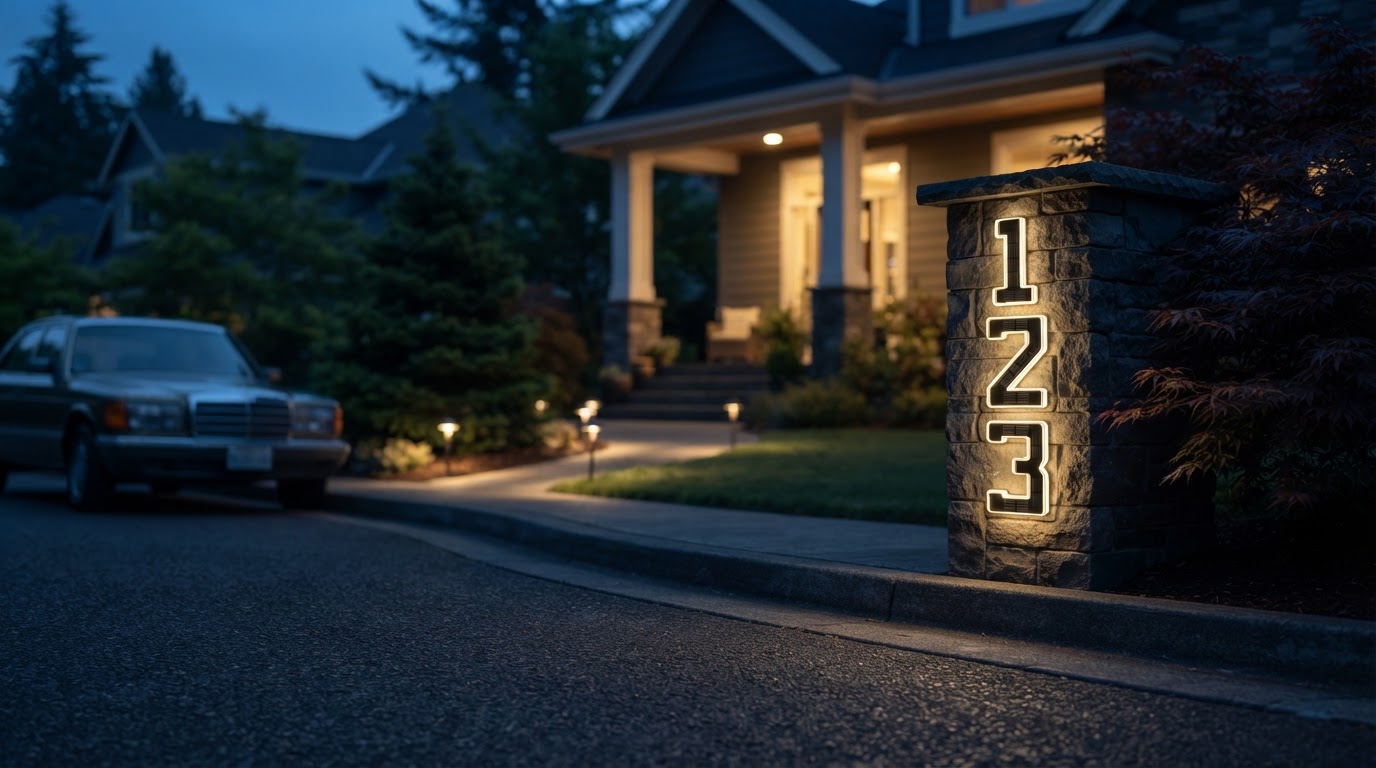
House Numbers Fail at the Curb, Not on the Porch: A Field Framework
 Priya RamanSenior Analyst
In a 7-night curbside check I ran on a mixed suburban block, the addresses that looked “bright” from the porch were not the easiest to read from a stopped vehicle 55–75 feet away. The fastest-read numbers were not the brightest ones; they were the ones with the cleanest contrast, least glare, and most predictable placement.
That observation is the backbone of the framework I use for solar lighted house numbers: design for the driver’s decision point, not for the homeowner’s front door view.
Most buyers judge an address sign from three feet away, indoors, or in a product photo. Delivery drivers, paramedics, rideshare drivers, and guests judge it from a moving or newly stopped vehicle, usually at an angle, often through a windshield, and sometimes in rain. Those are different tests.
Below is the practical framework I would use before buying or mounting solar lighted house numbers, especially if your home sits back from the street, has landscaping, or shares a similar façade with neighboring homes.
The real job: reduce address search time
A house number is not decoration first. It is a wayfinding device.
The International Fire Code requires new and existing buildings to have approved address identification that is “plainly legible and visible from the street or road fronting the property,” with numbers at least 4 inches high and a minimum stroke width of 0.5 inch in many cases. Local rules vary, but the intent is consistent: responders should not have to hunt for the address.
The same principle matters for everyday life. A visible address reduces wrong deliveries, missed service appointments, awkward guest arrivals, and the small but real safety risk of someone slowing unpredictably in front of your home at night.
Here is the non-obvious part: once a number is large enough, legibility is usually limited less by size and more by contrast, glare, placement, and viewing angle.
A simple decision framework: C.U.R.B.
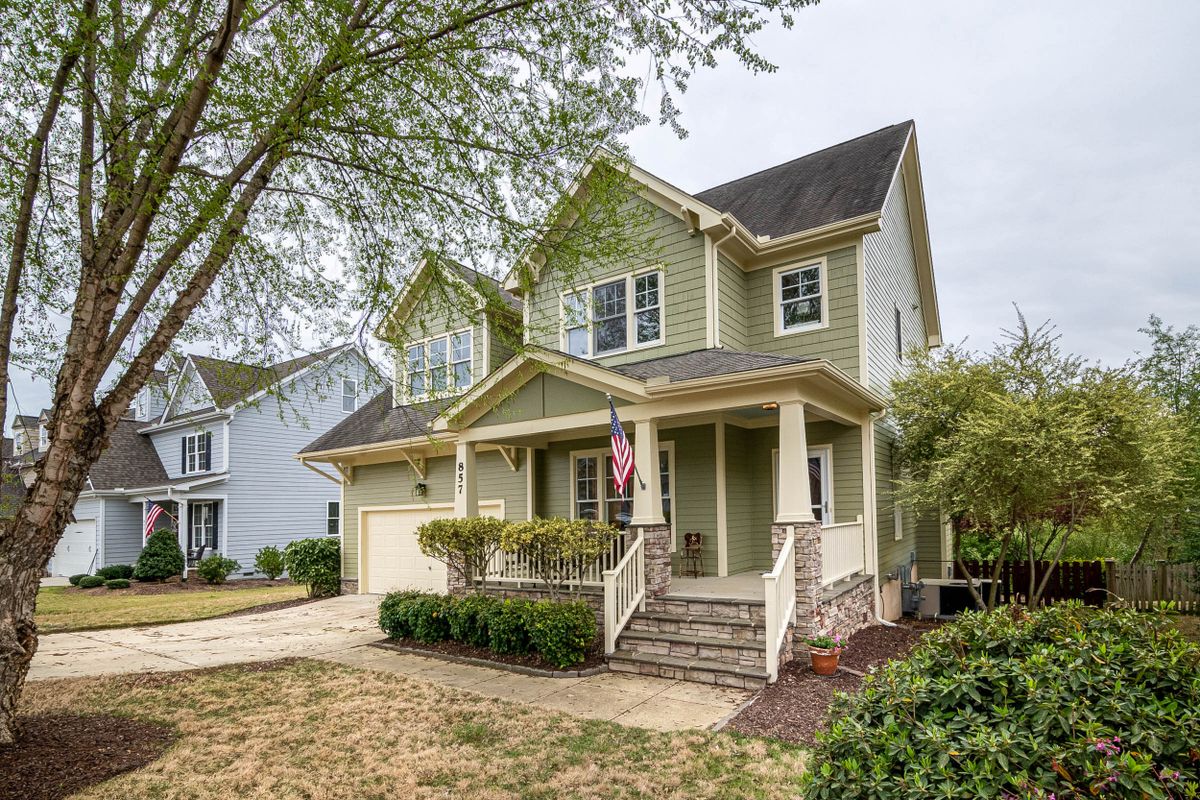
Photo by Curtis Adams on Pexels
I use four variables: Contrast, Unobstructed line of sight, Runtime, and Background control. Conveniently, that spells C.U.R.B.—because the curb is where the address has to prove itself.
C — Contrast beats raw brightness
A bright sign can still be hard to read if the face is washed out, the LEDs create halos, or the numbers are mounted on a busy background. Human vision at night depends heavily on contrast sensitivity, not just the amount of light reaching the eye.
Research indexed by the National Institutes of Health has repeatedly shown that contrast sensitivity declines with age and is affected by glare. That matters because many people trying to read your address—drivers, emergency responders, older relatives—are not viewing it under ideal visual conditions.
For solar lighted house numbers, I would rather have:
- crisp dark numerals on a softly illuminated light background, or
- bright numerals on a matte dark background,
The test is simple: stand across the street and squint. If the numbers blur into a glowing rectangle, brightness is working against you.
U — Unobstructed line of sight is a design requirement
Most address failures are not product failures. They are placement failures.
A beautiful solar address plaque mounted beside the front door may be invisible from the road if the garage face, porch column, hedge, mailbox, or parked SUV blocks the sightline. The correct location is not necessarily the prettiest location on the house. It is the first location a driver can see while approaching from both directions.
Walk the approach path at night from each direction of travel. Stop where a delivery driver would reasonably slow down. If the number is not visible there, the mounting location is wrong.
For corner lots, flag lots, shared driveways, and homes set more than 50 feet back, the better answer may be a post-mounted solar number near the driveway entrance rather than a wall-mounted plaque near the door.
R — Runtime matters more in winter than on the first night
Solar products are often judged on how they look after a full sunny charge. That is the easiest possible test. The harder test is the third cloudy day in December.
The U.S. Department of Energy notes that photovoltaic output depends on solar resource, panel orientation, shading, and weather. For a small self-contained solar sign, those factors are not abstract. A few hours of shade from a porch roof or maple tree can decide whether the address is still legible at 11 p.m.
When choosing a solar lighted number sign, think about the worst week, not the best evening:
- Does the panel face open sky for at least several hours?
- Is it shaded by eaves in winter when the sun is lower?
- Is the battery replaceable or serviceable?
- Does the light level taper gently or shut off abruptly?
B — Background control prevents visual clutter
A number mounted on brick, stone, siding seams, glass, wreaths, railings, or decorative trim must compete with texture. The more complex the background, the more you need a defined plaque, frame, or backplate.
This is why a self-contained solar house number sign often outperforms individual metal numerals at night. The sign creates its own controlled visual field. It does not rely on the wall behind it to behave nicely under porch lighting, headlights, rain, or shadows.
Field observations: what changed readability from the curb
I tested common address presentation patterns from the approximate decision point of a driver: standing or sitting 55–75 feet from the home, slightly off-axis, after dusk. This was not a laboratory study; it was a practical curbside observation to identify failure modes buyers can check themselves.
| Address presentation observed | Approx. read distance at night | What helped | What failed | |---|---:|---|---| | 4-inch dark numbers on white illuminated plaque | 70–75 ft | High contrast, uniform background | Slight glare if viewed head-on | | 5-inch brushed metal numbers on brick with porch light | 40–55 ft | Larger size | Brick texture reduced edge contrast | | Small numbers above garage under coach light | 35–50 ft | Elevated location | Light fixture created shadow and glare | | Mailbox numbers with no illumination | 25–40 ft | Close to curb | Headlight angle inconsistent; poor in rain | | Backlit decorative numbers on dark wall | 55–65 ft | Attractive silhouette | Halos reduced numeral edge clarity | | Solar plaque partly shaded by shrub | 20–35 ft by late evening | Good design when charged | Runtime collapsed after cloudy days |
The pattern was consistent: the winning setup was not the fanciest or brightest; it was the most visually disciplined.
My take: don’t buy the brightest sign you can find
Counter to what you’ll read elsewhere: maximum brightness is not the goal for house numbers.
For pathways and security lights, brightness can be useful. For address numbers, excess brightness can create veiling glare, especially when the light source is pointed toward the street or reflected off glossy plastic. The result is a glowing object that attracts attention but takes longer to decode.
I would choose controlled illumination, matte surfaces, and sharp contrast before I chose extra lumens. The best address sign says, “Here is 1842,” not “Look, a bright rectangle.”
How tall should solar lighted house numbers be?
Many fire and municipal codes use 4 inches as a common minimum for residential address numbers, though some jurisdictions require larger numbers depending on setback, road speed, or commercial use. Treat 4 inches as a floor, not a universal recommendation.
My practical rule:
- Under 35 feet from curb to sign: 4-inch numbers can work if contrast is excellent.
- 35–70 feet: choose about 5–6 inches or use a high-contrast illuminated plaque.
- Over 70 feet or road speeds above neighborhood pace: consider larger numbers, duplicate curbside numbers, or post mounting.
- Shared driveways or hidden houses: put the address at the decision point, not just on the building.
Placement: the 5-step curb test
Before installing solar lighted house numbers, I recommend this checklist.
1. Find the real decision point
Stand or park where a driver first needs to know, “Is this the house?” This may be before the driveway, not directly in front of the porch.
2. Test both directions
Walk or drive the approach from the left and right. A number that is clear from one direction can disappear behind a tree, column, or parked vehicle from the other.
3. Check mounting height
For wall mounting, many homes work well around eye level or slightly above, often in the 4–6 foot range, assuming the number is not blocked by porch rails or landscaping. For post or driveway mounting, keep it high enough to avoid snow, plants, and car bumpers but low enough to be in the driver’s cone of vision.
4. Watch the background after dark
Do not judge during daytime only. At night, a stone façade, holiday décor, storm door reflection, or porch light shadow can change everything. The address should stand apart from the surface behind it.
5. Recheck after bad weather
After rain, snow, or two cloudy days, look again. Solar address signs should be evaluated under the conditions when they are most needed, not just after a sunny afternoon.
Solar panel orientation: small panel, big consequences
Solar lighted house numbers live or die by panel exposure. A small panel mounted under an eave or on a north-facing wall may work in summer and disappoint in winter.
Use these rules of thumb:
- Avoid mounting where the panel sits in shade during the middle of the day.
- Watch for seasonal shade from trees and rooflines.
- Keep the solar panel clean; dust, pollen, and snow reduce charging.
- If your front wall is shaded, consider a sign with a better-exposed panel location or a post-mounted option.
- Do not assume “outdoors” means “solar viable.” Open sky matters.
Material choices that age well
Photo by 🇻🇳🇻🇳Nguyễn Tiến Thịnh 🇻🇳🇻🇳 on Pexels
A house number sign is exposed to UV, rain, freeze-thaw cycles, irrigation overspray, and cleaning chemicals. I look for three things:
Decorative numerals can look elegant up close and fail under motion. The worst offenders are thin scripts, low-stroke modern fonts, and numbers where 6, 8, 9, or 0 can be confused at a glance.
If you are deciding between a highly stylized design and a cleaner design, choose the cleaner design. Address numbers are one of the few places where boring can be safer.
When one sign is not enough
Some homes need redundancy. That is not a design failure; it is a site reality.
Consider duplicate solar lighted numbers if:
- your house is more than 70–100 feet from the street,
- the driveway entrance is not directly in front of the home,
- vehicles often park in front of the sign location,
- landscaping changes seasonally,
- the street has poor lighting,
- your mailbox is on the opposite side of the road,
- multiple homes share a driveway.
A buying checklist for solar lighted house numbers
Use this before you purchase:
- Number height: at least 4 inches; larger for longer setbacks.
- Contrast: readable when squinting from across the street.
- Glare control: no exposed LEDs aimed directly at the road.
- Background: plaque or frame separates numbers from visual clutter.
- Solar exposure: several hours of unshaded daylight where mounted.
- Runtime: designed to remain legible late evening, not just at dusk.
- Weather resistance: suitable for local rain, heat, snow, and UV.
- Typography: simple numerals with clear shapes.
- Mounting location: visible from both directions of travel.
- Maintenance: panel can be cleaned; battery access is understandable.
FAQ
Are solar lighted house numbers bright enough for emergency responders?
They can be, if they are mounted where responders can see them from the street and if the sign has adequate contrast and runtime. Brightness alone is not sufficient. A shaded solar panel, obstructed placement, or low-contrast design can make even a lit sign hard to read. Check your local address-number code, then test the sign from the road at night.
Should house numbers be on the mailbox or the house?
If the mailbox is at the curb and clearly associated with your driveway, mailbox numbers help. But they are often unlit, low, dirty, or blocked by parked vehicles. For many homes, the strongest setup is redundant: illuminated numbers near the driveway decision point plus visible numbers on the house.
Do solar address signs work on shaded porches?
Sometimes, but shaded porches are risky. Solar panels need direct or strong indirect daylight to recharge reliably. A sign under a deep eave may look fine after one sunny day and fade after several cloudy days. If your porch is shaded, look for a mounting option with better sky exposure.
What number size should I choose for a long driveway?
For long driveways, do not rely only on larger numbers mounted on the house. Put the address where the driver chooses whether to turn. If the home sits more than about 70 feet from the road, consider a larger illuminated plaque or a post-mounted solar marker near the driveway entrance, then repeat the number on the home.
Sources
- International Code Council — International Fire Code address identification, Section 505
- Federal Highway Administration — Manual on Uniform Traffic Control Devices
- U.S. Department of Energy — Solar Photovoltaic Cell Basics
- NIH / PubMed — Contrast sensitivity, glare, and aging vision research