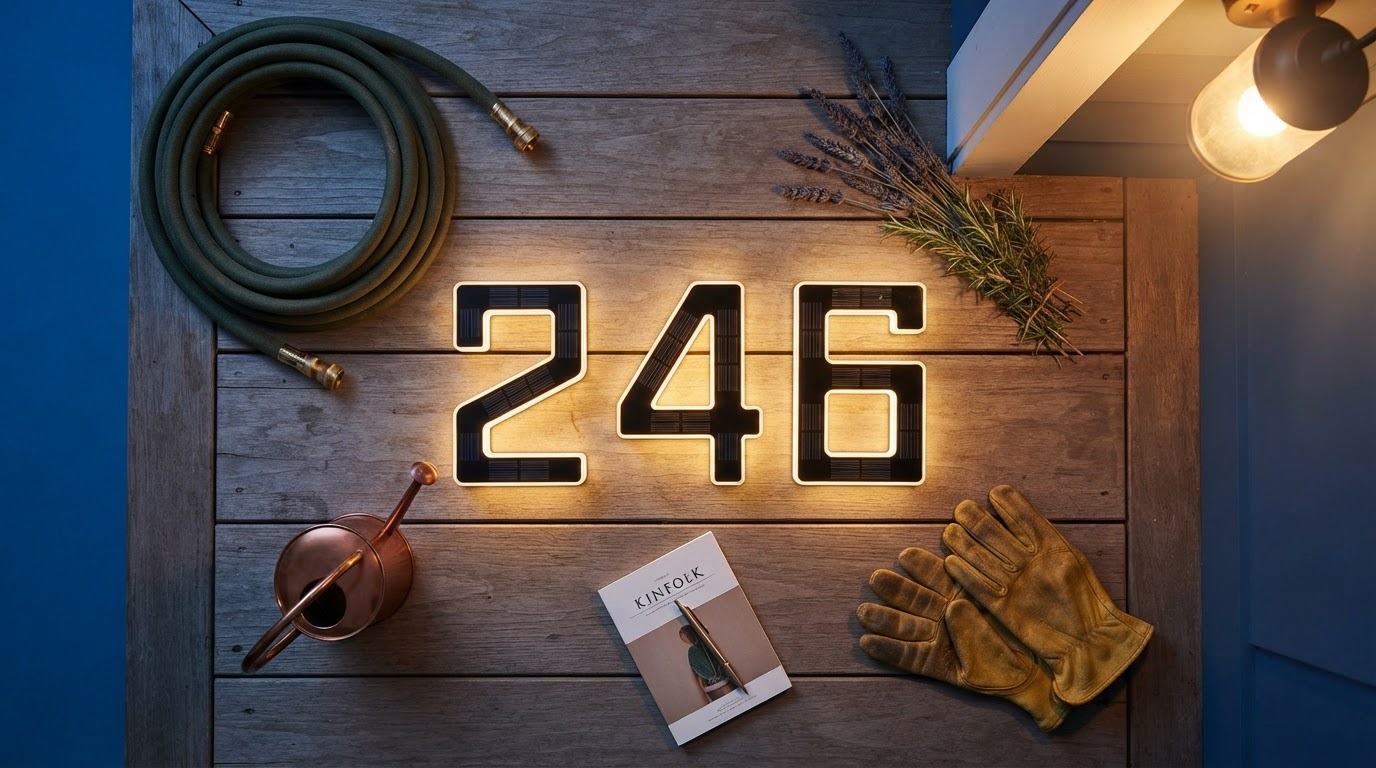
Choosing a Solar Address Sign for Yard Visibility
 Jordan HaleStaff Writer
October 21, 2026
Finding a home in the dark should not feel like a game of chance, yet many residential entrances remain shrouded in shadow once the sun dips below the horizon. This guide examines how a solar address sign for yard placement provides a reliable, wire-free solution for homeowners, emergency responders, and delivery drivers alike.
The Challenge of Low-Light Navigation
The first thing I noticed was how quickly my own driveway disappeared after 6:00 PM. Living in a neighborhood with deep setbacks and mature trees, the standard house numbers pinned to my siding were essentially invisible from the street. This isn't just a matter of convenience for the pizza delivery person; it is a critical safety gap. Emergency services frequently cite poor house numbering as a primary cause of delayed response times. According to Address America, high-visibility signage, particularly those featuring 6-inch numbers on both sides, significantly improves identification from the roadway. When a sign is placed at the curb rather than on the porch, it cuts down the search time for anyone approaching at speed.
Standard reflective stickers often fail because they require a direct beam of light from a vehicle's headlights to activate. If a car is turning or if the angle is slightly off, the reflection dies. This is why the shift toward active illumination—specifically solar-powered LEDs—has become the preferred standard for modern property management. Unlike traditional wired lighting, which requires trenching through a manicured lawn to run electrical conduit, a solar address sign for yard installation is self-contained. It captures energy during the day to power a consistent glow throughout the night. I found that without this dedicated light source, even the most expensive brass numbers become mere shapes in the dark, providing no functional benefit when it matters most. Integrating a solar house address plaque with light ensures that the focal point of your property's identification is always powered and prominent.
Performance Standards for Solar Address Signs
Somewhere around week two, I realized that not all solar cells are created equal. A high-quality solar address sign for yard use must balance battery capacity with LED efficiency to survive the long nights of winter. The internal components typically consist of a monocrystalline solar panel, a rechargeable NiMH or Lithium-ion battery, and a light-sensitive dusk-to-dawn sensor. For a sign to be effective, it needs to produce enough lumens to be legible from at least 50 feet away without being so bright that it creates a glare. Many homeowners are now opting for backlit house numbers solar designs, which project light behind the numerals to create a floating, high-contrast effect that is exceptionally easy on the eyes.
It turns out that the physical height of the stake is just as important as the light itself. A sign that sits too low to the ground can be obscured by snow, tall grass, or parked cars. Most professional-grade yard signs utilize a staked system that elevates the numbers at least 15 to 24 inches off the turf. This elevation ensures the solar panel remains above the "splash zone" of mud during rainstorms and catches the maximum amount of unobstructed sunlight. When considering the durability of these units, look for weatherproofing ratings of IP65 or higher. This ensures the internal circuitry is protected against the driving rain and humidity that often causes cheaper plastic alternatives to flicker and fail within a single season. By choosing a robust solar address plaque for yard use, you are investing in a permanent fixture rather than a temporary plastic novelty.
A Framework for Selecting Your Sign
When you begin comparing different models, the sheer variety of aesthetics can be overwhelming, ranging from modern minimalist steel to traditional decorative scrolls. However, the decision should always lead with functionality. I keep coming back to the idea that a sign is a tool first and a decoration second. You want a design that complements your landscaping while maintaining the strict legibility required by local fire codes. For those with long driveways, a solar lighted house numbers for yard setup with double-sided numbering is essential so that traffic coming from either direction can identify the home.
Before making a final selection, verify the mounting hardware and the quality of the numerals. Some kits use adhesive stickers which can peel over time, while others use laser-cut acrylic or metal that is bolted to the frame. The latter is always preferable for longevity. Also, consider the color temperature of the LEDs; a warm white (3000K) often looks more upscale and matches residential landscape lighting, whereas a cool white (6000K) offers the highest possible contrast for maximum readability. If you prefer a wall-mounted look but need it closer to the street, you might even consider a solar house address plaque with light attached to a dedicated wooden post or mailbox pillar.
- Battery Runtime: Ensure the unit specifies at least 8-10 hours of illumination on a full charge.
- Number Height: Look for numerals that are at least 4 inches tall; 5 or 6 inches is ideal for street visibility.
- Material Integrity: Prioritize aluminum, stainless steel, or UV-resistant ABS plastic over thin, brittle polymers.
- Panel Placement: Check if the solar panel is integrated into the top of the sign or if it is a separate, adjustable component that can be angled toward the south.
- Auto-Sensing: Confirm the inclusion of a photocell sensor for automatic dusk-to-dawn operation.
- Contrast: High-contrast combinations, such as black numbers on a white frosted background or white numbers on a dark metal plate, provide the best night-time legibility.
Shop Solar Lighted House Numbers here