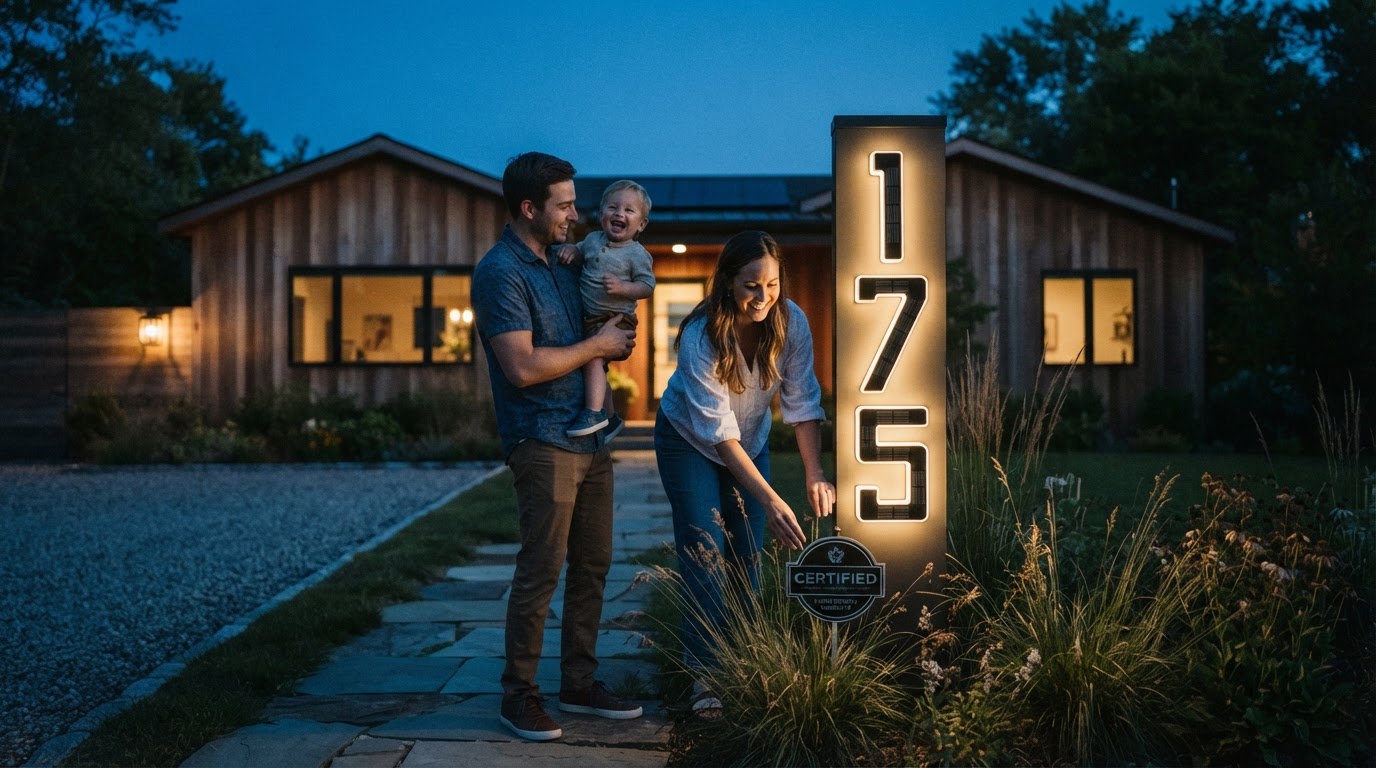
Installing Solar Lighted House Numbers for Yard Visibility
 Maya ChenContributing Editor
November 19, 2026. This technical overview examines the deployment of solar powered house numbers for yard placement to solve the failure of wall-mounted signage in deep setbacks. It is written for homeowners who require verifiable visibility for emergency services and logistics providers.
The Failure of Standard Wall Signage
The conventional wisdom says that a well-lit porch light is sufficient for address identification, but logistics data and emergency response times suggest otherwise. When a home is set back more than 30 feet from the curb, or when mature landscaping obscures the primary structure, a wall-mounted number becomes functionally invisible from the street. This is particularly problematic in residential zones where street lighting is inconsistent. According to Address America, address signs that include integrated solar lamps are designed to add distinction and class while solving the fundamental problem of automatic dusk-to-dawn illumination. Without these dedicated yard markers, drivers often rely on GPS alone, which can have a margin of error of 15 to 50 feet—frequently the difference between your driveway and your neighbor's. Here's the part nobody talks about: standard reflective numbers lose efficacy as they accumulate road grime and pollen, whereas an active LED source maintains a higher contrast ratio through atmospheric interference. While solar lighted mailbox numbers provide a baseline for identification at the property edge, they are often too low to be seen over parked vehicles. For properties with complex layouts, solar lighted house numbers for navigating dark yards serve as essential wayfinding beacons that bridge the gap between the curb and the front door. This is not about aesthetics; it is about reducing the cognitive load on a driver searching for a specific coordinate in low-light conditions.
Technical Performance of Yard-Mounted Solar LEDs
Transitioning from passive signage to solar powered house numbers for yard use requires an understanding of photovoltaic efficiency and LED lumen output. Modern units, such as those found at Selegna Signs, utilize weatherproof, made-to-order enclosures that house dusk-to-dawn sensors. Run the math: a typical high-efficiency solar address sign requires approximately 4 to 6 hours of direct solar exposure to power a 10-lumen LED array for a full 10-hour winter night. If the yard placement is shadowed by a canopy for more than 50% of the daylight cycle, the battery discharge rate will eventually exceed the charge capacity, leading to premature failure. This is why placement in the yard is superior to the porch; it allows for the optimization of the solar panel's angle relative to the southern sky. For those managing solar lighted house numbers for long driveways, the yard-mounted stake or plaque acts as the primary visual anchor. These systems often feature backlit LED house numbers solar configurations, which provide a silhouette effect that is easier for the human eye to process at a distance than direct-glow LEDs. Unlike DIY solar address sign ideas that often use repurposed landscape path lights with insufficient wattage, professional-grade solar address signs for yards are engineered with specific battery chemistry—typically Lithium-ion or NiMH—to handle the high-cycle demands of 365-day operation. When selecting a unit, prioritizing an illuminated address sign with a clear, sans-serif font is more critical than matching the architectural style of the home, as legibility is the only metric that matters in an emergency.
Implementing a Yard-Based Address Strategy
Choosing the right solar powered house numbers for yard installation involves more than just sticking a stake in the ground. The height of the sign must account for snow accumulation and local vegetation growth to ensure the LED address plaque remains visible year-round. A common mistake is placing the sign too close to the street where it is prone to splash-back from rain or salt, or too far back where it loses the benefit of the solar address sign for yard placement. As noted in the EASY! How to Choose the Best Solar House Number Light & Install It video guide, size is a primary factor—bigger is almost always better for long-range recognition. I'll change my mind when smart-home integrated lighting becomes more reliable than a standalone solar cell, but for now, the independence of a solar-powered unit is its greatest strength. It functions even during grid outages, providing a critical service when it is needed most. When evaluating your yard for a new installation, follow this technical checklist:
- Verify a minimum of 5 hours of unobstructed southern exposure for the solar collector.
- Select a mounting height at least 18 inches above the average local snow line.
- Ensure the font height is at least 4 inches for visibility from 50 feet away.
- Check for interference from existing street lights that might trigger the dusk-to-dawn sensor to stay off.
- Opt for IP65 or higher weatherproofing to protect the internal battery from moisture ingress.
Shop Solar Lighted House Numbers here.