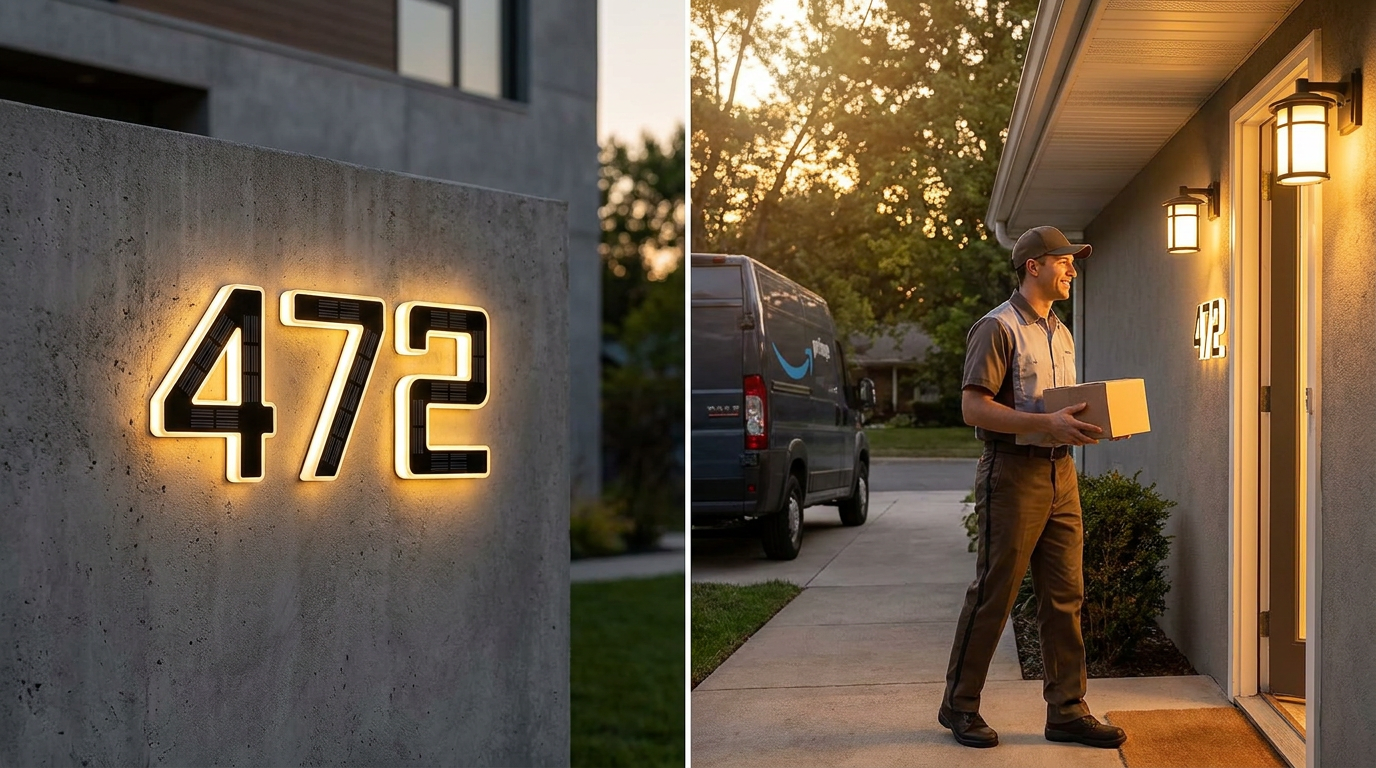
Optimizing Visibility with Solar Lighted House Numbers
 Sam VasquezBuying Guide Lead
June 8, 2026. This comparison examines the efficiency and reliability of dusk-to-dawn sensors in residential address signage. It is written for homeowners who need consistent night-time visibility for deliveries and emergency services.
The Challenge of Nighttime Address Identification
Finding a specific home after sunset is a persistent issue for delivery drivers and visitors, but it becomes a critical safety concern when seconds matter. Standard reflective numbers often fail when street lighting is poor or when a vehicle's headlights aren't angled perfectly toward the structure. According to Selegna Signs, an automatic light sensor that activates at dusk and switches off at sunrise ensures that the LED illumination behind address numbers remains consistent throughout the night without manual intervention. Without this automation, homeowners often forget to flip a switch, leaving their home invisible during the hours it is most vulnerable. This lack of visibility is why many are moving toward solar lighted house numbers for emergency response as a standard home improvement. If you rely on a porch light that you frequently forget to turn on, your house is effectively unnumbered for half the day. This creates a friction point for courier services and, more importantly, can delay life-saving assistance. I have seen many properties where the numbers are technically present but functionally useless because they lack a dedicated light source.
Comparing Dusk-to-Dawn Solar House Numbers Performance
When evaluating hardware, I look at how the sensor interacts with the battery capacity. BacklitLEDsign offers Dual-Lit Solar House Numbers for approximately $35.00, featuring a waterproof design and a dusk-to-dawn sensor that simplifies the installation process. Between a basic reflective sign and a dedicated LED unit, I would go with the LED unit every time because it provides its own light source rather than relying on ambient light. These systems use a small photovoltaic cell to charge an internal battery during daylight hours. As the sun sets, the voltage drop from the solar panel signals the LED array to ignite. The primary differentiator in these units is the quality of the LED and the housing. Many users searching for backlit led house numbers solar are looking for that specific silhouette effect where the light glows from behind the digit, making it legible from a distance. If you are on a budget, a simple stake-mounted solar address plaque for the yard is a functional entry point, but it lacks the architectural integration of a wall-mounted backlit version. We often discuss whether solar lighted house numbers aid emergency responders, and the data suggests that active illumination is significantly more effective than passive reflection. The reliability of these units depends on their placement; a sensor shaded by an eave may trigger too early or fail to charge, which is a common pitfall in the dusk-to-dawn setup for solar lighted house numbers.
A Framework for Choosing Your Address Lighting
Choosing the right hardware depends on your property’s layout and your local climate. Skip this if your house is less than 10 feet from a well-lit street lamp, as the ambient light may prevent the dusk-to-dawn sensor from ever activating. For everyone else, here is what I would actually buy: a unit with a high-capacity lithium-ion battery and a minimum IP65 waterproof rating. You want a sign that can survive a week of overcast days without going dark. When comparing options, check the Kelvin rating of the LEDs; a warm white (3000K) is usually more legible and less harsh than a cool blue-white (6000K). Consider the following checklist before purchasing:
- Verify the sensor type: Ensure it is a true dusk-to-dawn photo-resistor and not a motion sensor.
- Check the mounting hardware: Solar powered house numbers for fences require different brackets than those for brick walls.
- Assess the battery access: High-quality units allow you to replace the rechargeable battery after a few years of cycles.
- Measure the digit height: For visibility from the curb, numbers should be at least 4 inches tall.
- Evaluate the solar panel angle: If your house faces North, look for a unit with a detachable or adjustable solar panel.
Sources
Photo by Star Zhang on Pexels
- Dual-Lit Solar House Numbers – Waterproof LED Address Plaque ...
- Lighted House Numbers & Solar LED Address Signs